

Curso online: Using art as a classroom resource
Conocer, idear, desarrollar... Using art as a classroom resource es un curso, destinado a docentes de Educación Infantil y Primaria, que pretende explorar las posibilidades del arte como vía para la enseñanza del inglés.
Impartido íntegramente en lengua inglesa, el curso está diseñado para ofrecer a los profesores herramientas para la creación de recursos educativos a través del arte. Se pretende, además, que la iniciativa sirva de apoyo a cualquiera de las materias que se imparten en inglés en los niveles de Educación Infantil y Primaria.
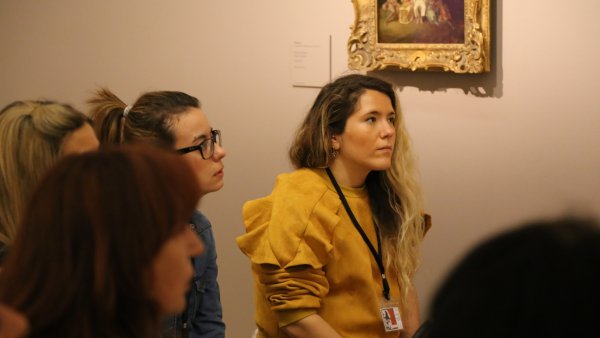
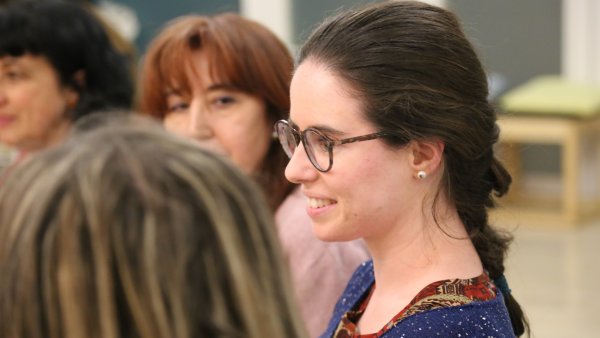
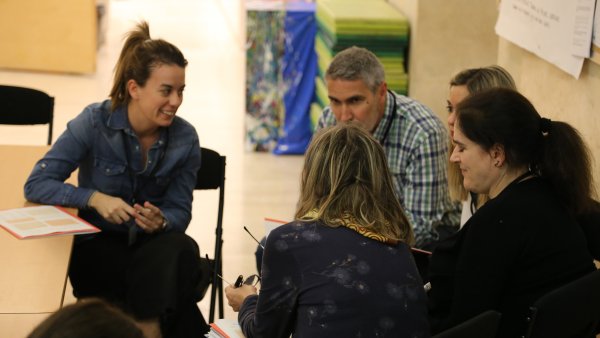
Durante el desarrollo de las distintas sesiones combinamos diferentes metodologías de aprendizaje, clases teóricas y prácticas junto con propuestas de trabajo y de generación de contenido basadas en el intercambio de ideas. Las obras del museo, se convierten de este modo en el nexo común en torno al cual reflexionar y compartir experiencias en relación a la lengua, la cultura inglesa, el patrimonio artístico y los vínculos interculturales.
Observaciones. 1. Actividad dirigida a profesores de la Comunidad de Madrid en activo. 2. Los profesores de centros concertados y privados y los profesores interinos deberán enviar por FAX (91 572 03 20) o por correo certificación actualizada de estar prestando servicios en su centro, antes de finalizar el periodo de inscripción. 3. Es necesario disponer de cuenta de correo electrónico en EducaMadrid a efectos de inscripción y seguimiento de la actividad. 4. Con el fin de compartir y difundir las aplicaciones didácticas más destacadas elaboradas por los asistentes, se recomienda incluir los datos del autor y la licencia "Creative Commons by-sa". 5. Los docentes admitidos en el curso que, sin causa plenamente justificada, no lo inicien o lo abandonen, no podrán participar en ningún otro curso durante los 12 meses siguientes.
¿Qué requisitos existen para la obtención del certificado? 1. Asistencia al total de horas de la fase presencial del curso. 2. Valoración de las actividades de formación según lo establecido en el capítulo II, artículo 5 de la Orden 2883/2008, de 6 de junio, BOCM Núm. 149, por la que se regula la Formación Permanente del Profesorado.
¡Importante! El curso se encuentra dirigido a docentes de Educación Infantil y Primaria que hayan obtenido la habilitación lingüística en idiomas extranjeros (especialidad inglés) y que desempeñen puestos bilingües en centros docentes públicos y concertados de la Comunidad de Madrid. También está destinado a inspectores de Educación e interinos en lista (sin centro).
¡Nota! Todos los inscritos pueden acceder al curso a través del aula virtual de la Comunidad de Madrid.

Hi again, Gonzalo!
Thank you very much for your comment. I would like to know more about your experience in California. What a coincidence! I think you will find very interesting the next session of this course, because we invited to María García Puente, who is a Spanish teacher at CSUSB. We have collaborated with her on a project that she will explain in her session. I hope you like it!
I agree with you, there is a lot things done in the Community of Madrid's bilingual education system, but others to do and to improve the system. From the museum, this attention to bilingual education is a very small percentage of all our educational activity. This course is one of those initiatives, but from the museum's education department we are always open to collaborative with initiatives come from teachers. We will keep in touch!
Best regards,
Why the school is so important for the museum? Why the museum is important for schools?
In my opinion, this relationship between schools and museums is bidirectional.
On one hand, museums must give a response to the interests and motivations of the population. Thus, children are a very important percentage of that group of people: educating and forming them in artistic knowledge will be decisive to keep this love for art along their lives and those who are next to them.
On the other hand, museums are decisive for the learning-teaching process. They are a sample of all the richness and beauty human being has created for centuries. Learning to appreciate it, apart from the academic or technical knowledge, will inspire on them values such as respect, hard work, persistance, motivacion, empathy…
To sum up, both influences are essential for us, as a species, to keep progressing, expressing through art and understanding the others.
Would you like to be part of a community of practice for the improvement, research and innovation in the bilingual education? What is your idea?
Being part of a community like this one would be really interesting and, of course, I would be glad to be in.
The fact that it would be a bilingual project is a good hook since it would open wide possibilities to the research among different countries and cultures.
Besides, as a teacher, it is always positive to keep learning and looking for new things, new ways of thinking, new alternaties that, for sure, are going to benefit ourselves and our pupils.
Any project would be great but, taking into account that we are in a museum context and we are all teachers, I think that it would be great if a research about how children are represented in paintings along history is carried out. This could include learning and researching about theis lives, theis interests and their feelings. Furthermore, in a futuristic way and after working on it with the children, we could imagine and create new painting about how do we imagine children in paintings in the future!
Hello Paula,
Thank you for your answer. If you really find interesting to be part of teacher’s community, you will surely like to know about our project called Musaraña. Although it is not a community focused on bilingual education, It is a growing community of teachers in which we organize many events for free. We all together learn artistic methodologies for teaching and share our experiences. Feel free to browse all the resources generated in the web space created specifically for the Musaraña community:
https://www.educathyssen.org/profesores-estudiantes/musarana
Best regards
Hi Paula!
I am sorry for the delay in this answer but as a teacher myself, adapting to this new on-line teaching status hasn't been easy.
Though our course is now finished and since our idea was to engage in a community or at least keep in touch for sharing resources, I wanted to challenge you with something. I found the idea of how children are represented in paintings along history really interesting. I found the collection browser very interesting and I use it a lot when developing resources. That is why i used it to find several pictures in which children appear in different circumstances. Some of them, are used in our own tours, but I would like to see how you (or anyone that want to try) can make some kind of connection between them. Maybe create some kind of small resource, make an explanation to your own students or see how they can be used to deal with some issues in the classroom. You don't have to connect them all, because I am giving you lot of examples. I thought it would be a good way to start with your topic of interest.
there they go: I hope you find them interesting
https://www.museothyssen.org/coleccion/artistas/ruysdael-salomon-jacobsz-van/escena-invierno-patinadores-trineos-ciudad
https://www.museothyssen.org/coleccion/artistas/peale-charles-willson/retrato-isabella-john-stewart
https://www.museothyssen.org/coleccion/artistas/strub-jakob-yo-hans/visitacion
https://www.museothyssen.org/coleccion/artistas/brown-john-george/maton-vecindario
https://www.museothyssen.org/coleccion/artistas/homer-winslow/escena-playa
https://www.museothyssen.org/coleccion/artistas/freud-lucian/reflejo-dos-ninos-autorretrato
https://www.museothyssen.org/coleccion/artistas/denis-maurice/corona-margaritas
https://www.museothyssen.org/coleccion/artistas/balthus/partida-naipes
https://www.museothyssen.org/coleccion/artistas/maes-nicolaes/tamborilero-desobediente
best regards,
Good morning everybody!
First of all, a lot of strength to everyone with this situation we are going through.
Why the school is important for the museum? Schools are essential for museums because it is in the school where we can find the future generations of users of cultural products. Therefore, if we manage to show interest from a young age, we will be building future consumers of culture in all areas.
Why the museum is important for the school? Museums are a source of resources for our subjects. We can work all areas in a multidisciplinary way using the resources that a museum offers. In addition, museums serve to motivate students towards Art and all the benefits that it brings us.
Hello Laura,
Thank you very much for your answer. I understand what you mean, however I would like, if you allow me, to pay attention to some of the words that you have used to express your idea. Some of these words come from the field of economics as "product" and "consumer", and although the studies that have been applied to museums from economics are also interesting, we must be careful with these concepts because sometimes they separate us from our field educational, in which we must understand the value of culture, as a value in itself, a value that cannot be translated only into quantitative economics values. The value of culture is also a qualitative value that it is more related to intellectual, emotional and social development of people. I think we agree on this. Greetings
Hello Laura,
By reading you and Angeles' response, I would like to focus on one of your sentences:
if we manage to show interest from a young age, we will be building future consumers of culture in all areas.
(ignorig the consumers of culture part that Angeles has already solved)
Working with children from a young age and showing them Museums as a common place to visit is, in my opinion, a key concept in museum education, art education and, even more, EDUCATION in capital letters.
I have worked in the Museum for a few years now, performing our Family Program in wich we try to engage the whole family in the art activity. I found out tat Art Education starts always at home. As everything in our young live, we learn to do what our parents do. And it's their responsability to introduce them in museum life and cultural education. Therefore it's our challenge (teachers' and museum educator's) to show the parents how enriching the cultural experience can be.
As part of the bilingüal program, we had some English activities for families in wich it happened that families came because of the "English" part. Wich is a shame. Although most of them wanted to share an activity as a family and both combien art and English.
I realised that cultural related families are more eager to come and join us in these tours. Our own colleagues from the museum had brought their children, we've had actors and singers with their own...etc. Even my very own baby came to the museum when he was only two weeks old!!! hahaha
I hope among all we can find a way to engage children in culture from the very beginning.
Create an educative community learning
To strengthen this relationship between the school and the museum is important to build a community of practice.
In this last six years of working with bilingual schools, the relationship between teachers and museum educators has been occasional and brief.
When there is an interest from the school, the teachers enrol their group in one of the activities in the museum, they meet the educator at the place and share that moment. After finishing the activity, the school and the teacher never see each other again.
This relationship is likely to be improved. Our proposal is to create a community of educative practice. The community allows to go beyond what you can expect individually, improve the quality of education and to improve the physcho-social environment for students. It allows as well innovation and introduces opportunities for change.
Who could be part of this community? All those people that have a similar interest in the bilingual education.
Who will be eligible?
At this point we would like to present you the second question:
¿Would you like to be part of a community of practice for the improvement, research and innovation in the bilingual education? ¿What is your idea?
In order to answer these questions, let us say how teachers can do to be part of a community for this improvement. First of all, let us point out that most of the times when a a teacher has the opportunity to get her students to an activity, the teacher is likely to have no information about the contents and development of the activity itself. So the first thing I would change about it would be to be better informed so she can make a kind of warming up with students before it and they already have some expectations and facilitate the museum educator's job. This warm-up would be as easy as a brainstorm, look for information about the museum, a discussion about the name of the museum and what pupils know about it, drawing a "famous" painting it "holds", etc depending on the students' age.
Secondly, for the main task in my opinion it would be interesting on the one hand that the teacher and the educator have a previous contact before the session itself, at least via email. Both can exchange some useful information and the teacher can let him/her know important aspects such as the existence of students with special needs such as an autistic child and how to cater his necessities, for instance use very simple language, not being figurative, use visual resources, etc. On the other hand, the teacher can be involved in the activity so she can break barrier with students' without losing authority but creating an non-threating and friendly atmosphere.
Finally, personally, the learning would be meaningful if a postactivity such as miniproject would be asked to be done at students' homes or even the classroom if possible and some evidence could be taken such as photos. Then, we can make sure that students assimilated the notions and what should be explained again. Moreover, a feedback from both teachers and students such as a survey can be taken in order to know what can be improved. All these results, would be sent to the museum educator so he/she can feel gratified after the work done since the emotional aspect is also important and with the aim to encourage more groups of students to take part into the museum visit.
hi esther!
I found your ideas very interesting. there are many ways of working as a museum educators and though in the Thyssen -Bornemisza Museum we gererally work by welcoming the students here with "no previous contact", our "Hecho a Medida" program (https://www.educathyssen.org/programas-publicos/educacion-accion-social/hecho-medida-adultos ), works with adults with diverse educational needs, and they have been workins in different sessions for a long time. They have previous meetings with the teachers and then the group comes to the museum. Athough we have found that this way of working is only possible when you have less groups than the amount they usually manage in the museums. But I know is very enriching for all.
I once experience an acivity in te Vasarely Museum in Budapest wich combined both English and art, since the head of the Education department there is an american who is veri interested in bilingüal education in museums. Her team developed an activity in which they had two sessions. The firs one was in the school, and the educators went there to perform a very short activity to show them how to build reported speech sentences. Then, the second session was in the museum and they practice some more advanced English by using the paintings there. I have to say that the activity was for Secondary School Students and that the English contents were really prominent but they enjoyed much and, as an educator myself I learnt a lot.
What I meant to say is that there are many ways of working in museum education and all of them have their pros and cons. The best way of working is the way that best works for our class. Unfortunatelly it may not be the same for the other students. It is good that we can share about this and try to improve the way Museums and Schools work together.
regards,