

Curso online: Using art as a classroom resource
Conocer, idear, desarrollar... Using art as a classroom resource es un curso, destinado a docentes de Educación Infantil y Primaria, que pretende explorar las posibilidades del arte como vía para la enseñanza del inglés.
Impartido íntegramente en lengua inglesa, el curso está diseñado para ofrecer a los profesores herramientas para la creación de recursos educativos a través del arte. Se pretende, además, que la iniciativa sirva de apoyo a cualquiera de las materias que se imparten en inglés en los niveles de Educación Infantil y Primaria.
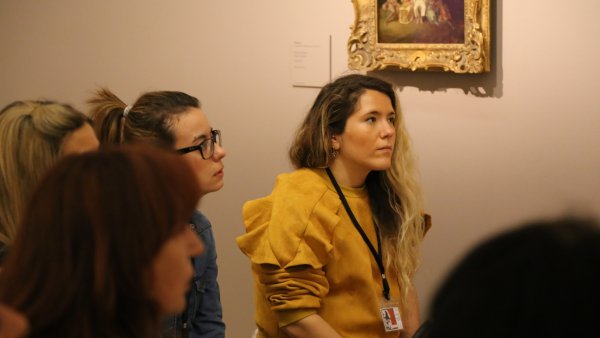
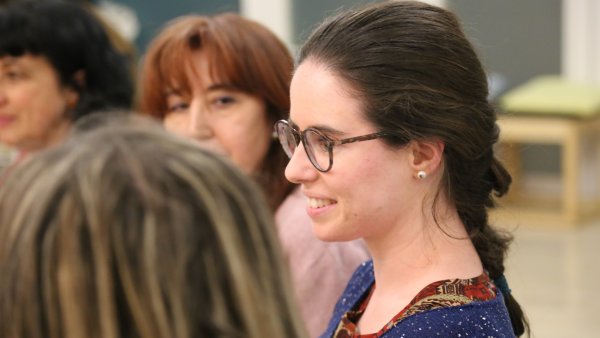
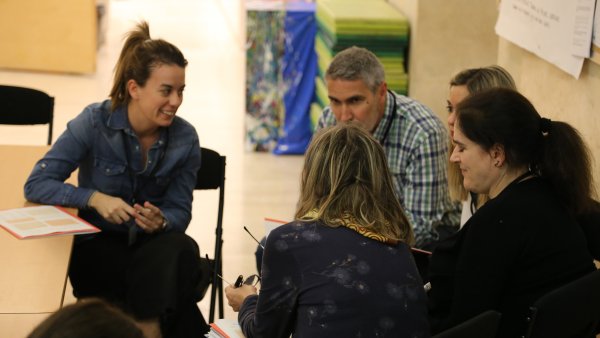
Durante el desarrollo de las distintas sesiones combinamos diferentes metodologías de aprendizaje, clases teóricas y prácticas junto con propuestas de trabajo y de generación de contenido basadas en el intercambio de ideas. Las obras del museo, se convierten de este modo en el nexo común en torno al cual reflexionar y compartir experiencias en relación a la lengua, la cultura inglesa, el patrimonio artístico y los vínculos interculturales.
Observaciones. 1. Actividad dirigida a profesores de la Comunidad de Madrid en activo. 2. Los profesores de centros concertados y privados y los profesores interinos deberán enviar por FAX (91 572 03 20) o por correo certificación actualizada de estar prestando servicios en su centro, antes de finalizar el periodo de inscripción. 3. Es necesario disponer de cuenta de correo electrónico en EducaMadrid a efectos de inscripción y seguimiento de la actividad. 4. Con el fin de compartir y difundir las aplicaciones didácticas más destacadas elaboradas por los asistentes, se recomienda incluir los datos del autor y la licencia "Creative Commons by-sa". 5. Los docentes admitidos en el curso que, sin causa plenamente justificada, no lo inicien o lo abandonen, no podrán participar en ningún otro curso durante los 12 meses siguientes.
¿Qué requisitos existen para la obtención del certificado? 1. Asistencia al total de horas de la fase presencial del curso. 2. Valoración de las actividades de formación según lo establecido en el capítulo II, artículo 5 de la Orden 2883/2008, de 6 de junio, BOCM Núm. 149, por la que se regula la Formación Permanente del Profesorado.
¡Importante! El curso se encuentra dirigido a docentes de Educación Infantil y Primaria que hayan obtenido la habilitación lingüística en idiomas extranjeros (especialidad inglés) y que desempeñen puestos bilingües en centros docentes públicos y concertados de la Comunidad de Madrid. También está destinado a inspectores de Educación e interinos en lista (sin centro).
¡Nota! Todos los inscritos pueden acceder al curso a través del aula virtual de la Comunidad de Madrid.

¿Why museums are important for schools?
I strongly believe that museums and schools need to build a partnership since they can benefit from each other. Museums provide the excitement about learning in a different space which teachers cannot create in a classroom. Not only is learning focused on academic work but the social and emotional children’s development is also imprtant for our students learning. These skills are developed in museums programs which show students opportunities to make emotional connections with their pieces of art.
Museums allow students to enrich their learning in various fields and gain experiences.
¿Would you like to be part of a community of practice for the improvement, research and innovation in the bilingual education? ¿What is your idea?
I would like to be part of a community of practice for the improvement, research and innovation in the bilingual education because I would like to learn new ways of engaging my students in their learning processes. My idea is to find a link among history events and pieces of art so my students can contextualise what they are studying.
Hello Natalia,
I find very interesting what you said about finding a link among history events and pieces of art. When I studied my master in Teacher's Trainning, my Master's Thesis was precisely on "How to use the Thyssen-Bornemisza Collection to teach History"
If your are interested I could send you some info.
regards,
Would you like to be part of a community of practice for the improvement, research and innovation in the bilingual education? What is your idea?
I would like to be a part of a community of practice for the improvement, research and innovation in the bilingual education. In order to explain what is my idea, there are two aspects I consider we should take into consideration:
The first one is to analyse the school bilingual situation nowadays. We should ask ourselves questions as What do schools understand for bilingual education (just teaching a specific content subject in a Foreign Language or something more... )? or How are we (as teachers) doing it in our daily practice? From my view, the critical self reflection would be an interesting starting point.
The second idea is the professional commitment in order to build a community in the bilingual education. Our continuous training as teachers in this area is very important. In other words, study techniques and researches that are working all over the world and sharing ideas, resources, tasks and activities between teachers is essential. The coordination of teachers with the whole educative community (colleagues, administration and families) is a key aspect to achieve our goal.
Hi Ana,
Thank you very much for your answer. The community that you propose is very interesting. From the museum, this attention to bilingual education is a very small percentage of all our educational activity. This course is one of those initiatives but, we have another project called Musaraña, from some years ago which works great. Although it is not a community focusing only on bilingual education, It is a growing community of teachers in which we organize many events for free. We all together learn artistic methodologies for teaching and share our experiences. Feel free to browse all the resources generated in the web space created specifically for the Musaraña community:
https://www.educathyssen.org/profesores-estudiantes/musarana
Best regards,
Good afternoon everyone!
Why is the museum important for schools?
From my point of view, one of the main reasons why the museum is important for schools is because the museum gives all students the opportunity to develop the critical thinking and the love and value towards Arts, that will contribute to the whole personal development. We need to have in mind that in a school we find students from very different sociocultural and economical backgrounds; therefore, for some of our pupils, schools are the only way they have to know this world.
Besides, the museum is important for schools because it is a valuable tool with endless resources that we can use in our practice to teach our subjects. We can use museums as an instrument to motivate our students in order to develop the teaching and learning process.
Hi Ana, sorry for the delay in the answer.
I just wanted to point out the idea of the critical thinking that you have mentioned. I found out when working with young students (I mean 10-12 years old) that they had great difficulties when they try to shape their own oppinions. Leaving outside the obvious peer pressure to wich they are exposed, they find it hard to think if they like something or not, if they are interested in something or not, if they can do something or not. I , as you said, believe that the museum, and art in general can be a great tool to practice that.
When talking about art, they usually find it hard to express opinions or, if they do it, they are generally negative. I believe this is due to their lack of knowledge on the topic. And I personally think this is what happens to adults as well.
I made an online resource for my students and develope some kind of self guided virtual tour as a game for this quarentene days. After that I asked some questions that the students had to answer. One of them was "which was the painting that you liked the least?" The anwsers were very dissapointing. Either they randomly chose a painting from the first rooms because they were the ones they saw, and said something like I didn't like the painting of "Jesus in the Cross" because there was too much blood or they picked the painting and said extrange reasons not to like them (such as "it is too dark" ,"the colours were not bright" , "it is too impressionist"). These answers were disappointing because after the info I gave them about the paintings, you expect them to have learnt why the paintings are like that, and that there are some reasons to make art in a particular way
It is true that I may find them extrange but they made me think about what students of these ages value most in art. I believe they were only focused on colors because that's the only thing they know about when talking about art. A wider knowledge about what the artist is doing can be shared (better in person) to give them tools to shape opinions and learn from the other's.
Would you like to be part of a community of practice for the improvement, research and innovation in the bilingual education? What is your idea?
Let´s begin by assuming that bilingual education in Comunidad de Madrid is just a product designed for political marketing. The vast majority of teachers and families who in the past thought bilingualism would be great, now realize that its outcome is that students learn more English by paying the price of not achieving the desired skills and contents in Spanish. And both teacher and families feel prisoers of bilingual education: for schools steping out of the bilingual program is almost imposible, as it is for families as nowadays almost 9 out of 10 schools are bilingual: in Torrelodones, where I teach, there are six-seven Primary lines out of which only one is not bilingual.
So I would love to be part of a community of practice for the improvement, research and innovation in the bilingual education as long as the above point is assumed and acknowledged. I spent six years in a REAL bilingual school system teaching for Los Angeles Unified School District (California) where they really knew what bilingualism is all about. In fact, having taken a M.A. in Multicultural Education (which addressed the bilingual issue constantly) from Californi State University, along with my 26 years of teaching experience, both in a bilingual and non-bilingual environment, has given me a pretty good knowledge of how to produce fluent in English students whose Spanish is kept at high a level.
Hi Gonzalo, sorry for the late response. My teaching job has kept me extra busy these past few weeks. How interesting this experience in California that you mentioned!!!
I would like to share a few of my very own thoughts about bilingüal education, if you allow me. First I agree with you that the current system has a few gaps. The one that I found most important is the teacher's trainning. I believe some teachers are pushed to become bilingüal teachers before they are propperly qualified. This ends up in many problems. One, the obvious estress for the teachers, who find their ordinary methods old-fashioned. They do not work anymore. It is absurd to try to teach maths in English as you teach Maths in Spanish. So, they have to work even harder to develop new resources because, usually nobody gives much info about it. Now we can find many online resources (even the museum can offer some), to apply them in our class but everyone has to find the thing that works for them.
Another big problem that I find is that teachers not always have the English level to perform their lessons succesfully. It requires the ability to control the class in both languages and also to control the contents. I have experienced myself some lessons in wich the teacher was obviously lacking both. Not good.
When learning a language I found it really important not to focus on translation. This is a big issue in Spain because, traditionally, our English education has been based on this translation. When you really learn a language your mind can both understand and speak in the language without making this process of translation. There is a gap when you learn English and you stop doing that, and you can notice when it happens, life is suddenly much easier. hahaaha.
The price of not achieving the desired skills and contents in Spanish as you said would be another point of interest. And I believe is all related to the idea of learning the language first or learning the contents first and then translate. In my opinion, both are wrong. Those two processes must be done at the same time. And when they happen from the beginnig we must hold on to them. because, unfortunatelly the bilingüalism as we know it only applies in Spain to Primary Schools and many students loose it when they arrive to Secondary School. It's a shame.
WHY IS THE MUSEUM IMPORTANT FOR SCHOOLS?
Nowadays, children (and adults) are used to get information through computers and books, so in the end, what they see is not the real thing, but a picture of it. In the case of art, it is terrible that some people know works of art just from pictures and they have never seen “the real thing”. Having a close relationship with a museum helps avoid this and gets children closer to real art. Furthermore, these children will probably become adults who will be interested in art.
Museums also have a lot of resources that schools lack, so keeping a close relationship with a museum will let our students benefit from those resources, and will help both teachers and students broaden their minds and interests regarding art and education.
Besides the above, staying in touch with the museum staff enables teachers to learn new teaching approaches.
Hello Gonzalo,
Thank you very much for your answer. As you know, the relationship between museums and schools is one of the most important topic of our education department. We can even say that this relationship is the origin of education departments from all museums around the world. But this relationship, as another classmate has mentioned in his comments, has to be bidirectional. Teachers and students benefit from the museum's resources, but museum educators also benefit from the teacher’s experience, who are the ones who work with the students every day. Together we can contribute to the development of methodologies that improve the quality of teaching. That is just what we plan in our project called Musaraña. It is a growing community of teachers in which we organize many events for free. We all together learn artistic methodologies for teaching and share our experiences. Feel free to browse all the resources generated in the web space created specifically for the Musaraña community:
https://www.educathyssen.org/profesores-estudiantes/musarana
Best regards,